Multi-geometry pre-training, in short
Summary of T. Buss, H. Day-Hall, F. Gaede, G. Kasieczka, K. Krüger, P. McKeown, L. Valente, Transferable Fast Calorimeter Shower Generation via Multi-Geometry Pre-training, JINST 21 (2026) P10041, arXiv:2608.18233.
The problem
Detailed Geant4 simulation of calorimeter showers takes most of the computing budget of a high-energy physics experiment. Generative models can produce showers much faster, but so far each of them has been tied to the detector it was trained on, and every new geometry needed a large dataset of its own.
The idea
We describe a shower as a set of energy deposits, a point cloud, and give one shower model two numbers that characterise the calorimeter: its sampling fraction and its number of layers. The model is pre-trained once on many detectors and then fine-tuned on a detector it has never seen, with few showers from that detector.
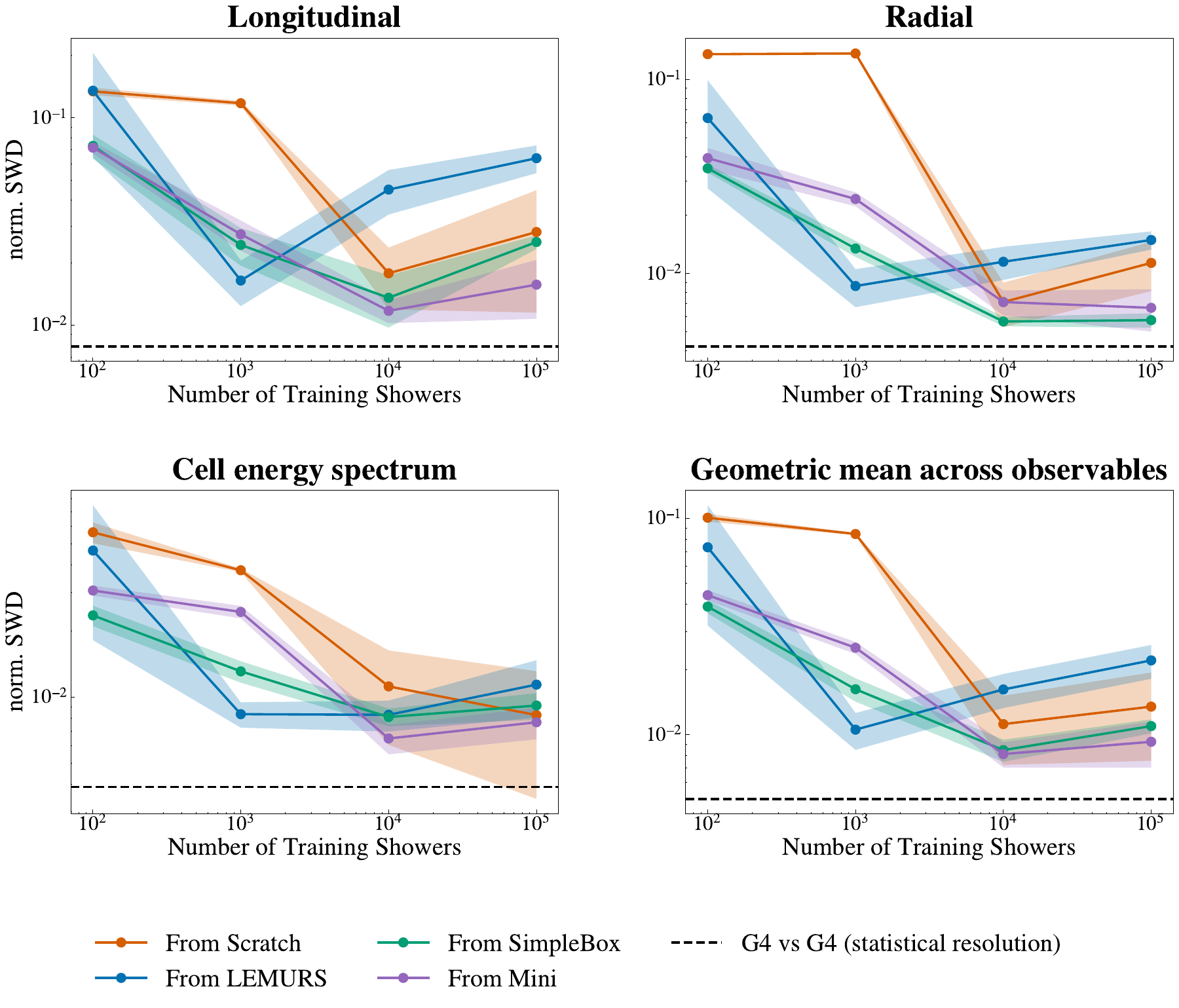
The pre-training detectors do not have to be real. SimpleBox is a family of 104 box calorimeters that spans the plane of sampling fraction and number of layers. We compare it with pre-training on four realistic calorimeters (LEMURS), with the same budget of four million showers.
What we found
On FCCee-ALLEGRO, a noble-liquid calorimeter outside the pre-training pool, with a thousand showers for fine-tuning, the sliced Wasserstein distance to Geant4 drops by a factor of 5.2 with the synthetic prior and 8.0 with the realistic one, compared with training from scratch. With more fine-tuning showers the synthetic prior performs better than the realistic one. On this target, geometric diversity is enough, and detector realism is not what makes the transfer work.
A compute-budget analysis places the break-even at about five downstream detectors in GPU-hours, and a pre-training on only 2.5% of the pool still beats training from scratch at every fine-tuning size.
Limits
The study covers photon showers only. Hadronic showers, which dominate the simulation cost, are not addressed. The two numbers fix the energy scale and the longitudinal sampling but not the lateral (Molière) scale of the material, which the model learns only during fine-tuning. The most extreme extrapolation, to ALLEGRO, is tested on one target. The natural next steps are a pre-training that covers all particle species and a conditioning on the full calorimeter description.
Code and data
Code: AllShowers and PointCountFM (multi-geometry branches). Datasets: University of Hamburg research data repository, produced with multi-calorimeter-dataset. Pre-trained weights: Hugging Face.