I work on generative models for the simulation of particle showers in calorimeters. Detailed simulation with Geant4 dominates the computing budget of collider experiments, and learned surrogates have so far been tied to the one detector whose data trained them.
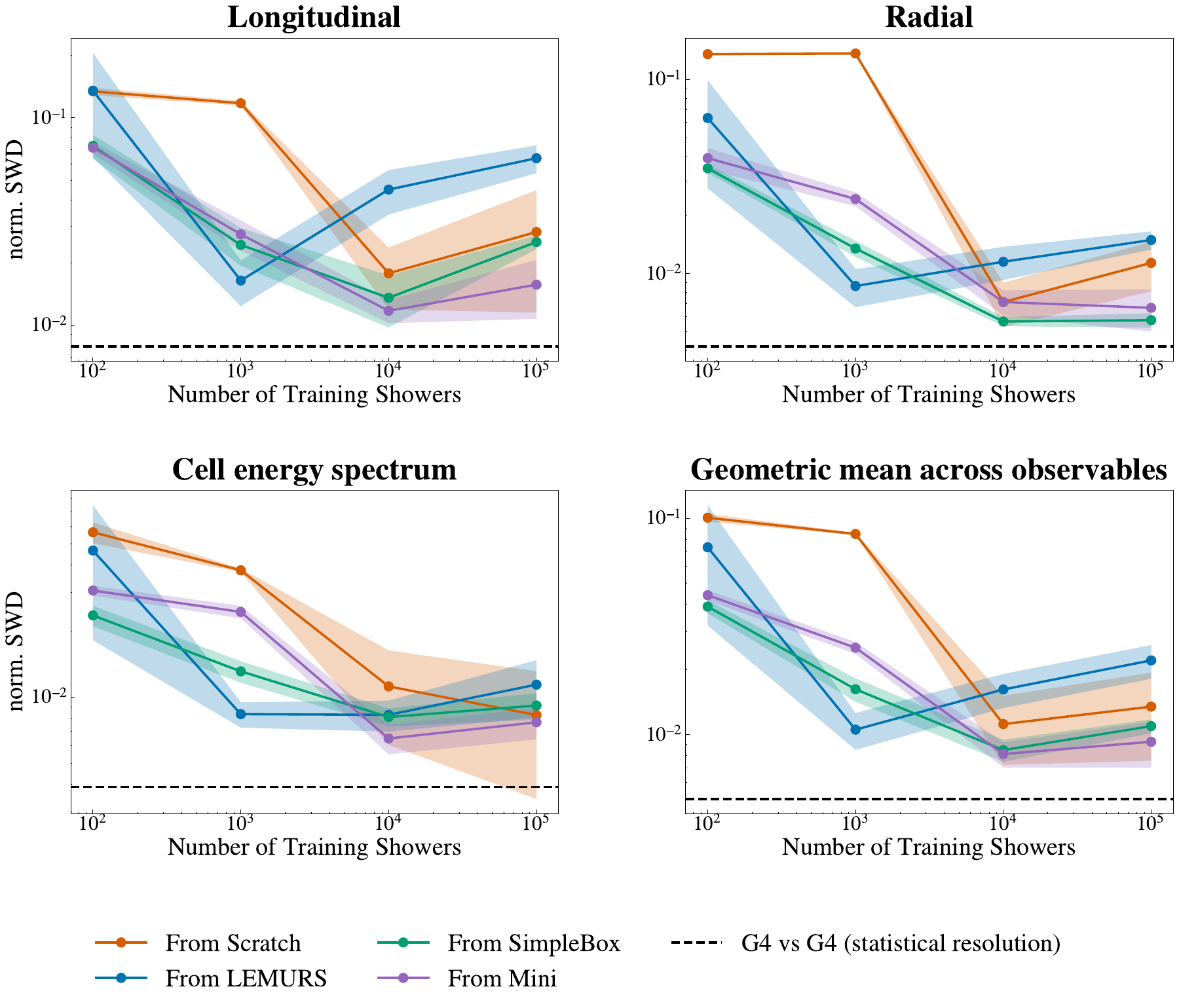
My thesis makes one generative shower model reusable across calorimeter geometries. Pre-trained on several detectors, it adapts to a new one with two orders of magnitude fewer Geant4 showers than a model trained from scratch.
I am a PhD candidate at the Institute of Experimental Physics of the University of Hamburg, in the group of Gregor Kasieczka. Before Hamburg I studied physics in Bologna, where my master's thesis was on real-time anomaly detection at CMS. I am also a classical pianist.
I extend a flow matching transformer for shower point clouds with conditioning on the calorimeter geometry and pre-train it across several detectors. Fine-tuned on a detector it has never seen, it needs two orders of magnitude fewer Geant4 showers to match a model trained from scratch on a full dataset (arXiv:2608.18233).
The first step was to show that a shower model trained on one calorimeter transfers to another with a fraction of the data (JINST 21 (2026) P07037).
The pre-training data are produced with Geant4 and DD4hep for a family of sampling calorimeters, from simulation to training-ready HDF5 (multi-calorimeter-dataset). The datasets themselves are on the University of Hamburg research data repository. Along the way I develop extensions to ddFastSim, the DD4hep fast simulation framework.
A numerical geometry descriptor as conditioning, towards a model that generalises to a new detector without any fine-tuning.
Full list on INSPIRE.